The Beatles
This is the Beatles wing of the Cliff Canyon web site. Start here to access all Beatle material.
rev: 2011Jun12
Record Release Orientation
The Beatles were a British band who recorded and released records in the United Kingdom
(UK). Master tapes of their songs were made available to a few companies in the
United States (US). Up through 1967, the US companies were free to release these
songs in any way they wanted. As a result, Beatle records released in the US
were totally unrelated to the Beatles' original work.
The Original UK Releases
The Beatles released 212 songs on an assortment of singles,
EPs, and LPs between 1962 Oct 05 and 1970 May 08.
Everything released thereafter was taken from these releases or from recordings the Beatles never intended to
release (studio outtakes, live performances, bootleg/pirate recordings, etc.).
To visit a page listing all the original, official, UK Beatle releases, click here.
US Releases
(for details on the following, see The Beatles US LPs)
The Beatles were a British band who recorded and released records in the UK. At that time, no British band had
ever had a hit record in the US. Songs released in the UK were often screened by US labels for possible release in
the US, but few were selected. In other words, in 1962, there was a bias in the US against UK recording artists.
The Beatles had a recording contract with Parlophone. Parlophone was one of several record labels owned by a
large UK company called EMI. EMI also owned a US record label, Capitol Records. As a result of this relationship,
Capitol had the first opportunity to decide whether or not it wanted to release a Beatles record in the US
(the "right of first refusal").
Capitol turned down the Beatles first three singles ('Love Me Do',
'Please Please Me', 'From Me To You')
and their first LP (Please Please Me). Brian Epstein and George Martin then had to find some other label
to release Beatle records in the US. They eventually uncovered a small rhythm and blues label in Chicago to release
them: Vee-Jay Records.
Capitol next turned down the Beatles 4th single ('She Loves You').
For various reasons (some colorful), Vee-Jay lost the rights to release any more Beatle songs. Epstein and Martin had to find another label to
release 'She Loves You'. They found a small Philadelphia label: Swan Records.
By the time the Beatles released their 2nd LP (
With The Beatles) and 5th single ('I Want To Hold Your Hand'), Beatlemania was spilling over
into the US. Capitol could no longer ignore the Beatles. They began releasing Beatle songs in the US starting with
the single 'I Want To Hold Your Hand'.
Although EMI owned Capitol, Capitol was given a completely free hand in deciding what to release and how.
Capitol would receive master tapes of Beatle songs from Parolphone. Capitol would then re-package and release them
in what they thought was the most commercially successful way. In some cases, songs were re-mixed by Capitol to give
them a more "American" sound. The Beatles had no influence or control over this process until 1968, when
The Beatles (the "White Album") became the first US LP to be identical to the UK original.
To visit a web page listing most of the US Beatle releases, click here.
Types of Records
There were three types of records released during the Beatle years, all played on record players.
The Single ("45")
The "single", also called a "45" because it rotated at the 45 revolutions per minute
(rpm) setting on the record player, featured one song on each side. A 45 had two
sides, designated as the "side-A" and "side-B". The song being promoted by the
record company (considered the most "commercial") was placed on the A-side, and
was the side most likely to be played on the radio. A single in the UK and US
were similar in most ways - the "hit" song was on the A-side and both spun at 45
rpm. However, the center of a UK 45 came with a center that could optionally fit
over a narrow or wide spindle. A 45 was usually refered to by the name of the
song on the A-side.
The EP
An Extended Play (EP) record was the same as 45 except there was more than one song per side. It sold
for more than a 45 but less than an LP. An EP had a title like an LP, which was
sometimes the name of the most commercial song on the EP. The EP format never
caught on in the US, although three Beatle EPs were released there.
The LP
A Long-Playing (LP) record was physically larger than an EP or 45, and contained more songs.
Further, an LP rotated at 33 and 1/3 rpms. An LP was the most expensive of the
three records. It had a title, sometimes taking the name of the most commercial
song on the LP.
Other Technologies
In the beginning (1962), mono recordings were the standard. Stereo equipment was new and few people owned any.
Few people owned tape recorders. Professional studios (like EMI) were recording with two-track tape decks.
All equipment used vacuum tubes. In the early years, Beatle records were only issued on plastic records
(not reel-to-reel, eight-track, cassette, CD, DVD, or anything else).
CDs
In the 1980s, legal agreements were finally reached allowing the Beatles catalog to be released on compact disc (CD).
As a result of that agreement, only the Beatles' original UK LPs were permitted (not US versions).
Compilation CDs were okay (like the Red and Blue CDs), but the original LPs were released as originally released
(although it was remixed for CD, resulting in some changes). All songs (singles) that were not originally
released on an LP were collected on two compilation CDs, Past Masters Volume One and Two.
Copyright ©2000, 2007-09,11 by Ken Westover at Cliff Canyon Publishing Co. All rights reserved.
This material may not be distributed without the written permission of the author.
E-mail questions or comments to
cliffcan@indra.com.
1106121517
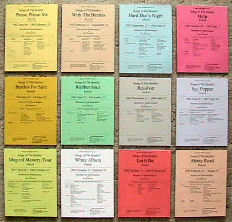 Ken Westover has written a 12-volume series of books about the music of the Beatles.
He divided the Beatles' career into Periods, one for each of the original albums, then wrote a book about each.
Ken Westover has written a 12-volume series of books about the music of the Beatles.
He divided the Beatles' career into Periods, one for each of the original albums, then wrote a book about each.